
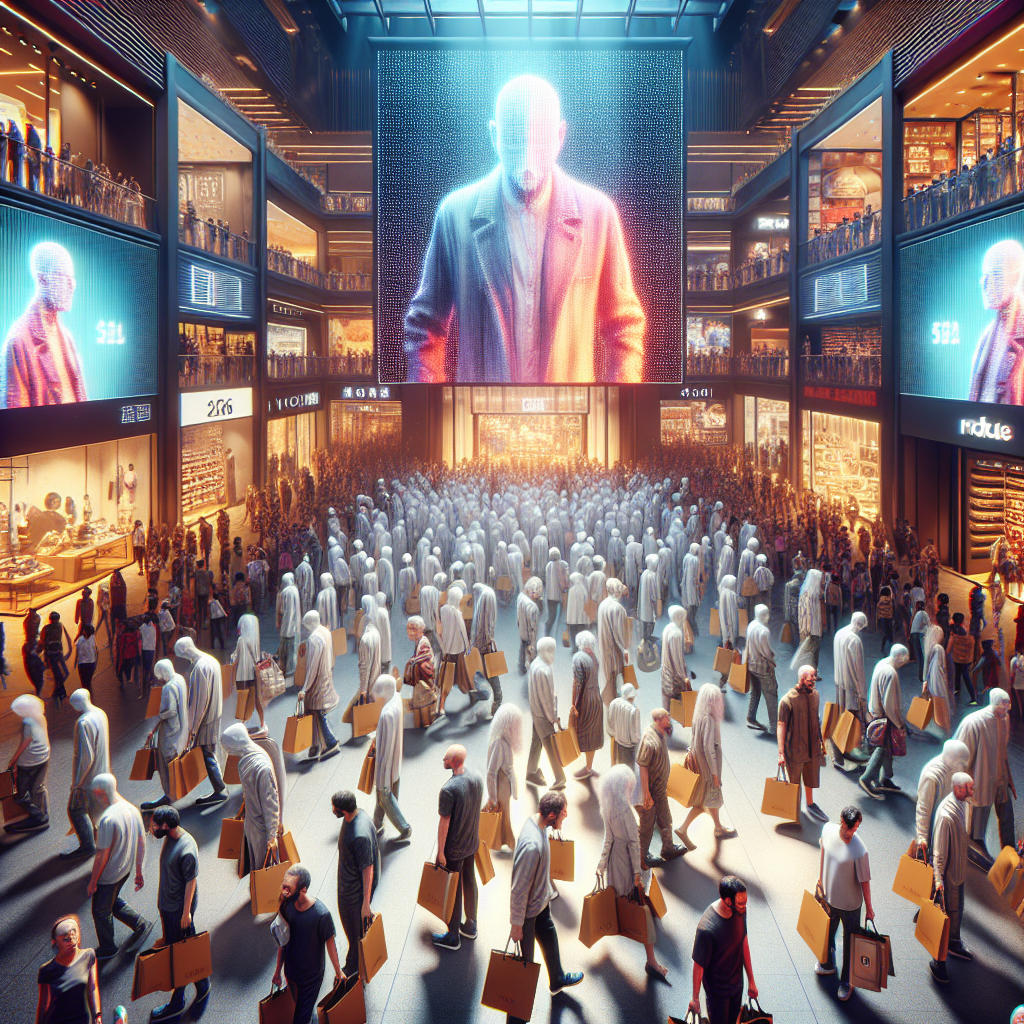
“Shopping: The Paradox of Belonging”
in Economic Synthesis, Political Synthesis, Writing on November 6, 2025
.
.
“Shopping: The Paradox of Belonging”
In a world teeming with products, the urge to shop paradoxically thrives, driven by commerce filling voids of modern uncertainty and isolation. Shopping provides a semblance of belonging, yet demands perpetual payment for acceptance, trapping individuals in a cycle of mutual insecurity. Consistency is bought, but genuine connection remains elusive.
**The Urge to Shop: Escapism, Belonging, and the Modern Economy’s Paradox**
In a world overflowing with products—where anything we desire is only a few clicks away—one might expect the urge to shop to diminish, each new purchase bringing diminishing excitement. Yet, shopping as a form of escapism remains as compelling as ever, if not more so. This paradox—about wanting things even when we already have them—reveals something deeper about how commerce fills the voids left by modern uncertainty, isolation, and the increasingly transactional nature of belonging.
**The Promise of Consistency**
In times past, connections between people—love, friendship, respect—were neither guaranteed nor cleanly transactional; they evolved organically, unpredictably, dependent on qualities both innate and developed. Today, these relationships are still fraught with uncertainty, sometimes even more so. Anyone, especially those who feel they lack “naturally desirable traits”—whether social skills, attractiveness, or simply the luck of circumstance—knows well the sting of feeling unwanted or excluded.
Commerce, by contrast, offers consistency. So long as a customer can pay the ticket price, acceptance is almost certain. Whether entering a luxury boutique or a big-box store, the doors are literally open, and, for a price, so is participation. There’s no complex social negotiation, no vulnerability, no need to wonder if one truly belongs. Businesses welcome all—especially those willing and able to pay. This is seductive, especially for those who feel rejected elsewhere.
**The Illusion of Community for a Price**
In this transactional refuge, a different kind of community forms—not built on mutual care or deep connection, but on mutual participation in the rituals of buying and selling. You belong as long as you pay. If your presence in a group of friends might be conditional, your presence in a store is certain.
However, this comes at a subtle cost. Shopping becomes a way to purchase a sense of belonging where organic belonging feels out of reach. The implication is almost existential: to continually belong, you must continually pay—like dropping coins into an old payphone just to keep the line open, or feeding quarters into an arcade game for one more turn.
**Debt, Inflation, and the Unstable Game**
Throughout history, money has rarely been easy to obtain. In harder times, even the promise to pay (debt) has allowed people to maintain the appearance of belonging or participation long after their resources were exhausted. This system is inherently precarious: when both buyers and sellers—often themselves marginalized or insecure—join together in artificial spaces of acceptance, a shared pretense arises: “We both act as if you belong as long as you keep paying.”
This game is inseparable from another lurking force: inflation. As prices rise, the effort needed to maintain this illusion of community grows. The objects themselves—shoes, phones, cars—may become less meaningful, but the *right* to buy them takes on ever-greater importance. The cost of “belonging” increases not just in dollars, but in labor, stress, and time.
**From Provision to Performance**
Work, once a means to meet tangible needs, becomes less about survival and more about signaling one’s worth—the size of the sign you wave to show your place in the pecking order. Shopping for status symbols—cars, clothes, homes—transforms reality. You aren’t really buying these things for their utility; you’re buying proof. You are broadcasting that you’re a provider, a person of means—even if, in truth, what you provide is increasingly abstract and less tethered to real productivity.
As one’s sense of inadequacy grows, so does the urge to buy more impressive tokens—always a step ahead of the growing emptiness left behind by compromised authenticity. The less valuable we feel our daily existence to be, the bigger and flashier our signs must become just to keep up the act.
**Trapped in a Pavlovian Loop**
Over time, this process becomes automatic. Like Pavlov’s dogs, we’re conditioned to reach for shopping whenever we feel anxious, isolated, or unwanted. Crucially, this is not because we need particular items, but because we fear what happens if we stop paying—if, that is, we stop participating in the rituals commerce offers us as substitutes for genuine belonging. Failing to pay, or even showing an inability to afford, feels like social death: exclusion from the only “community” that guarantees consistency.
**A Cycle of Mutual Insecurity**
And the insecurity is everywhere, even among those who seem most secure. Sellers themselves are often just as desperate, scrambling not to fall behind on their own obligations and to pay tribute up the chain. Everyone is moving with the herd—if only to avoid being trampled—fueling the same cycle that keeps everyone uncertain, isolated, and in desperate need of the temporary relief that shopping provides.
**Conclusion**
What makes shopping as escapism such a powerful urge is not merely the lure of new possessions, but the anxieties shopping answers—if only for a moment. In a world of relentless uncertainty, shopping offers the promise of acceptance and consistency, at least for a price. The cycle is inherently unstable, built on pretense and ever-increasing demands, and yet so seductive that we become conditioned to seek it out reflexively. In the end, this satisfies neither our need for real connection nor security, but so long as the doors remain open, it remains the most reliable refuge many can find—a testament to the deep, unfulfilled needs that underlie our endless urge to buy.