
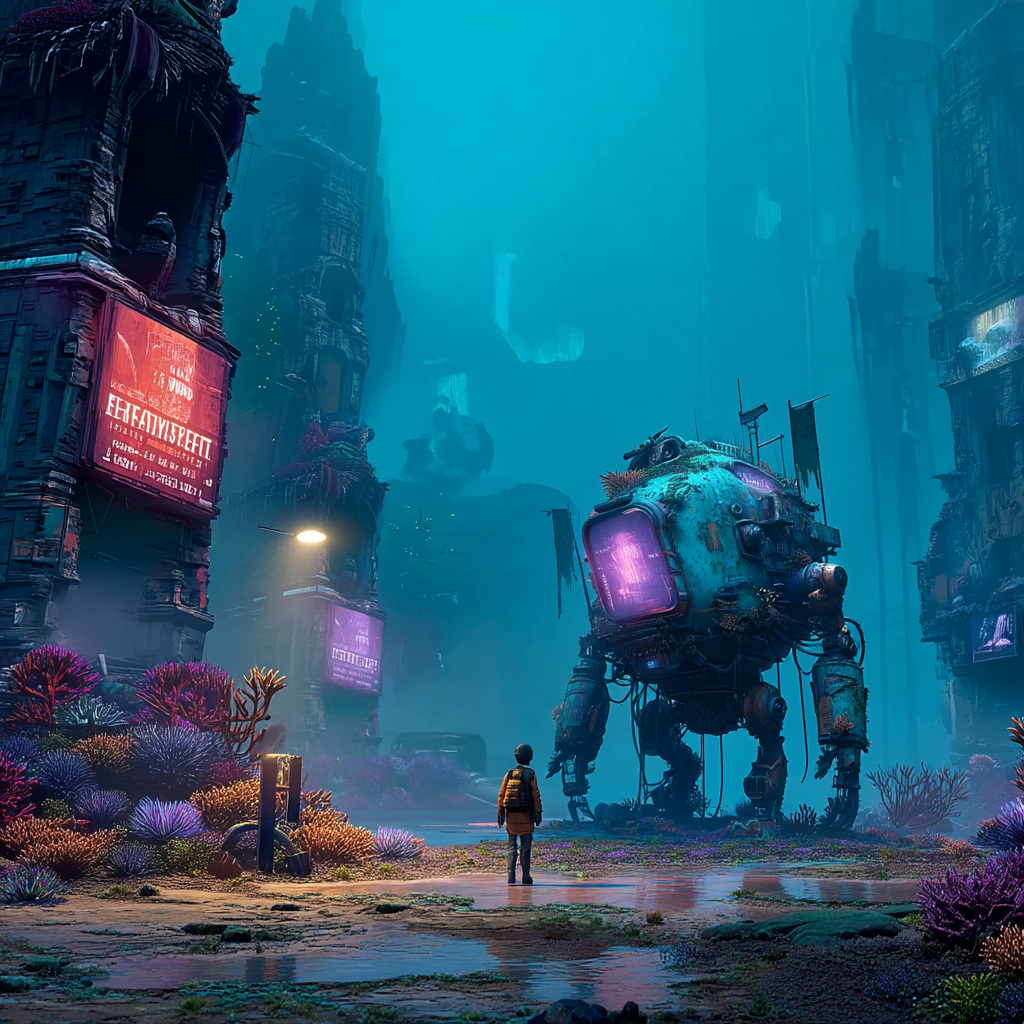
The city lay in spectral silence beneath a bruised, storm-lit sky. Shattered towers rose like teeth from the hollow plazas, their brutalist faces cracked and flaking, veined with soot and moss. Wind curled through steel skeletons, stirring dust that shimmered with glints of fractured glass. Phantom lights flickered across weed-clawed pavements, and the fog carried a hollow electric hum—as though the ghosts of circuits still dreamed beneath the ruins.
Through this desolation stood a figure both wondrous and unsettling: a coral-encrusted machine, its metal skin fused with reefs of pink and orange, glowing algae pulsing gently in its seams. Streamers of frayed undersea banners trailed behind it, whispering in the wind. With each step, the ground seemed to remember the ocean.
Nearby moved a wanderer wrapped in patchwork layers of corduroy and leather, his eyes sharp with mischief beneath the shade of a tattered hat. Charms and feathers swayed from his gray hair, and a silver amulet flickered at his throat, catching what little light dared pass through the fog. He studied the coral-clad robot with a bemused reverence, as if they shared a secret language only the ruins could translate.
Together they trudged across the haunted plazas until a sudden cackle split the air. From the yawning mouth of a half-collapsed tower came a wild-haired scientist, goggles askew, lab coat stained and pockets bulging with twitching gadgets. His eyes flashed with manic delight as he brandished a sparking device. The battle that followed sizzled and shrieked—plasma against coral, relic against invention—until his laughter turned derisive. He paused mid-swing to mock their ragged attire, calling them “fashion disasters of the apocalypse.”
Stung more by insult than danger, the two heroes exchanged a wounded glance, muttered curses, and stormed off into the fog, dignity trailing behind like torn banners.
The city center remained, unblinking beneath its bruised sky. Towers leaned over their reflections in puddles of acid rain, while weeds writhed through broken plazas. Across the ruins drifted the whisper of dust and the echo of laughter—half menace, half memory.
The scientist watched their silhouettes dissolve into the fog, his laughter faltering as the echo faded. The hum of the ruined city pressed close again, thick as static. He lowered his sparking weapon, its light dwindling to a faint tremor. For a moment, he stood very still, tasting the brittle air, wondering whether triumph still mattered when no one was left to applaud. The coral machine’s footsteps had left delicate impressions that shimmered faintly, tiny pools where luminescent organisms clung to debris. Against the ruin’s gray hush, they glowed like stubborn promises.
He moved closer, kneeling to touch the living residue. It pulsed once, receding as if shy of human warmth. “Even the machines evolve,” he murmured. It was not envy that burned him then, but recognition—somewhere beneath his defiant inventions, he too was trying to grow beyond extinction. The city, in its wounded majesty, responded with a low thrum: wind against hollow girders, a rhythm like heartbeats under stone.
In the distance, thunder rolled. He turned toward the sound, shoving his device into a coat pocket that sparked faintly in protest. The goggles slipped down over his eyes again, cool and familiar. He could not bear the vastness of stillness without their amber tint. As he began to walk, the rain thickened, and now and then lightning exposed his path—a sprawl of steel bones, moss, and echoes of glass.
Behind him, tiny coral polyps began to creep up the concrete where the machine had passed, spreading in soft galaxies of color. They would outlast the footprints of every living thing. The scientist smiled, though no one could see it, and whispered to the restless city, “Let’s see who reshapes whom.” Then he vanished into the storm’s throat, leaving only the pulse of growing light in his wake.