
**Manifesting Unintended Worlds: Creativity, Choice, and the Dimensions of Becoming**
Manifestation is a buzzword—often linked to self-help circles, vision boards, and optimism. The usual story suggests that if we focus hard enough, we’ll create the world we want. Yet, the creative process—especially in humans—is far more intricate. Paradoxically, we also manifest the worlds we desperately wish to avoid. This is perhaps made clearest through an unlikely metaphor: the journey of learning to draw.
### From Symbols to Mind’s Eye: The Artist’s Awakening
Imagine a novice learning to draw. Their initial goal is simple: can I make something, however rough, that others recognize? Maybe the drawing isn’t a Rembrandt, but a circle with two dots and a line communicates “face.” Over time, with persistent effort and curiosity, a new skill blooms. The artist’s “visual vocabulary” expands—lines become shapes, shapes become forms, and soon, the artist’s drawings are more eloquent.
At a certain point, something remarkable happens: the artist’s imagination leaps ahead of their skill. The blank canvas transforms; the artist “sees” a finished image before making a single mark. The process becomes less about creation from chaos, and more about revealing what is already “there” in the mind’s eye—like an explorer uncovering ruins lost beneath underbrush.
This is a sort of utopia for the artist: to create freely, guided by vision, skill, and intuition. The mechanical act of drawing slips away, replaced by a flow state. Yet, for many, the journey soon veers from utopia to something more troubling—a dystopia of creative paralysis and distorted paths.
### Trapdoors at Intersections: Choices, Paralysis, and Extra Dimensions
Every creative act is a series of choices, like forks in a road: Should I use blue or red? Realism or abstraction? Each decision carves out identity, style, and intention. The more skilled you become, the more nuanced and infinite these decisions become.
But creativity isn’t a straight or even branching line; sometimes, at an intersection, anxiety or doubt creeps in. Should you go left? Right? Or…wait? “Analysis paralysis” can freeze the artist, caught between options, unable to act. Life, however, doesn’t pause with indecision. The artist might spend years—or a lifetime—stuck mentally at a single creative fork.
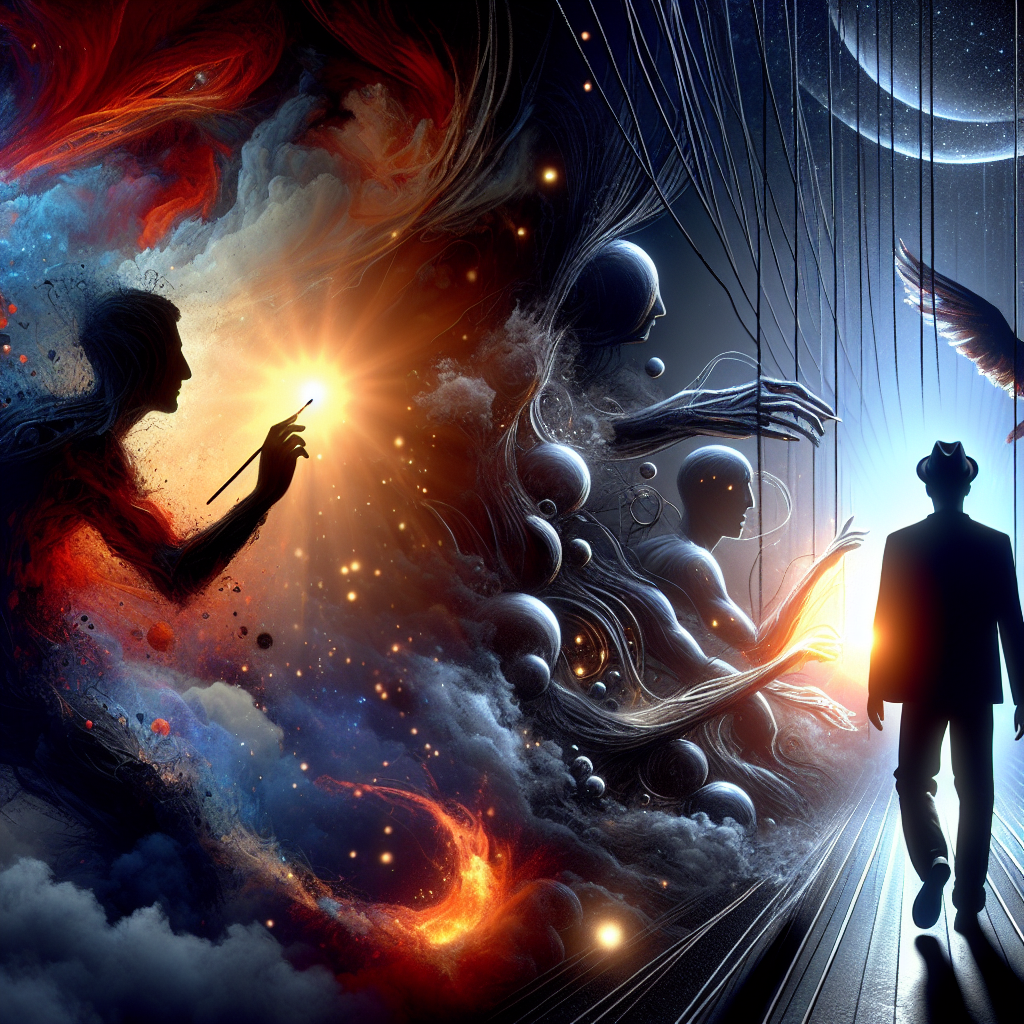
To outsiders, it may appear as if the person didn’t travel any path at all. But that’s not quite true. In reality, they have traveled a third, “extra-dimensional” path: the path of internal debate, doubt, and hesitation. This detour, though invisible to onlookers, is real to the artist—and perhaps even more exhausting. This is an “interdimensional” experience in that while the normal “paths” are tangible creative outcomes, the third path exists as an internal journey, full of loops and dead-ends.
### The Invisible Threat: When Fear Drives the Journey
But the paradox runs deeper. Consider someone else—the observer or critic—who notices the artist’s paralysis and becomes afraid of ending up similarly stuck. Their creative choices then transform; rather than choosing paths out of wonder or curiosity, they choose out of fear. Now, the journey is less about experiencing, expressing, or reaching an artistic destination, and more about fleeing the ominous threat of getting “stuck.” The path is traveled for avoidance, not for fulfillment.
This state is also a kind of dystopia. The act of creation becomes a desperate run from an intangible fear, not a move toward passion or discovery. The artist loses sight of their own path, blinded by the urge to escape. And, just like the indecisive artist, they end up lost—traveling through worlds not of their choosing.
### The Danger of Disrespected Gardens
Let’s layer in another twist: the effect of others on our internal universes. Suppose our artist has nurtured a vibrant “secret garden” in their mind—a personal vision and style, cultivated over years. When this inner world is finally shared, a disrespectful critic can damage the artist’s self-belief. The garden, once a source of confidence, becomes a place of insecurity.
If the artist can neither dismiss the critic nor adapt constructively, their vision collapses. They enter, once again, an extra-dimensional path—not just lost between choices, but now haunted by an invisible threat (public disapproval, self-doubt). Their journey becomes less about moving toward creativity, and more about running away from invisibility, inadequacy, or rejection.
### Becoming an “Interdimensional Traveler”
In both cases—the artist who never chooses, and the artist who always flees—neither ends up where they intended. Both are “interdimensional travelers,” caught in self-created worlds of inaction or fear. Ironically, they give up creating the world they want, and instead manifest the world they’re most eager to avoid. Their focus, whether stuck at an intersection or running away from ghosts, becomes the blueprint for their reality.
### Broader Implications: What Are We Manifesting?
While this meditation is framed in the context of learning to draw, its implications ripple outward. Every time we focus anxiously on what we don’t want—out of fear, out of insecurity, out of a desperate avoidance—we risk bringing those very realities into being. Whether in art, relationships, career, or self-image, we must consider: are we moving toward something we genuinely desire, or endlessly running from something we cannot see?
The creative journey, then, is not just about mastering technique, but also about mastering our engagement with the infinite dimensions of choice, doubt, and perception. If we can learn to recognize these hidden paths—not as traps, but as inevitable terrains in the landscape of becoming—we may finally begin to manifest a world closer to our true vision, not just the shadow of a world we’d rather avoid.