
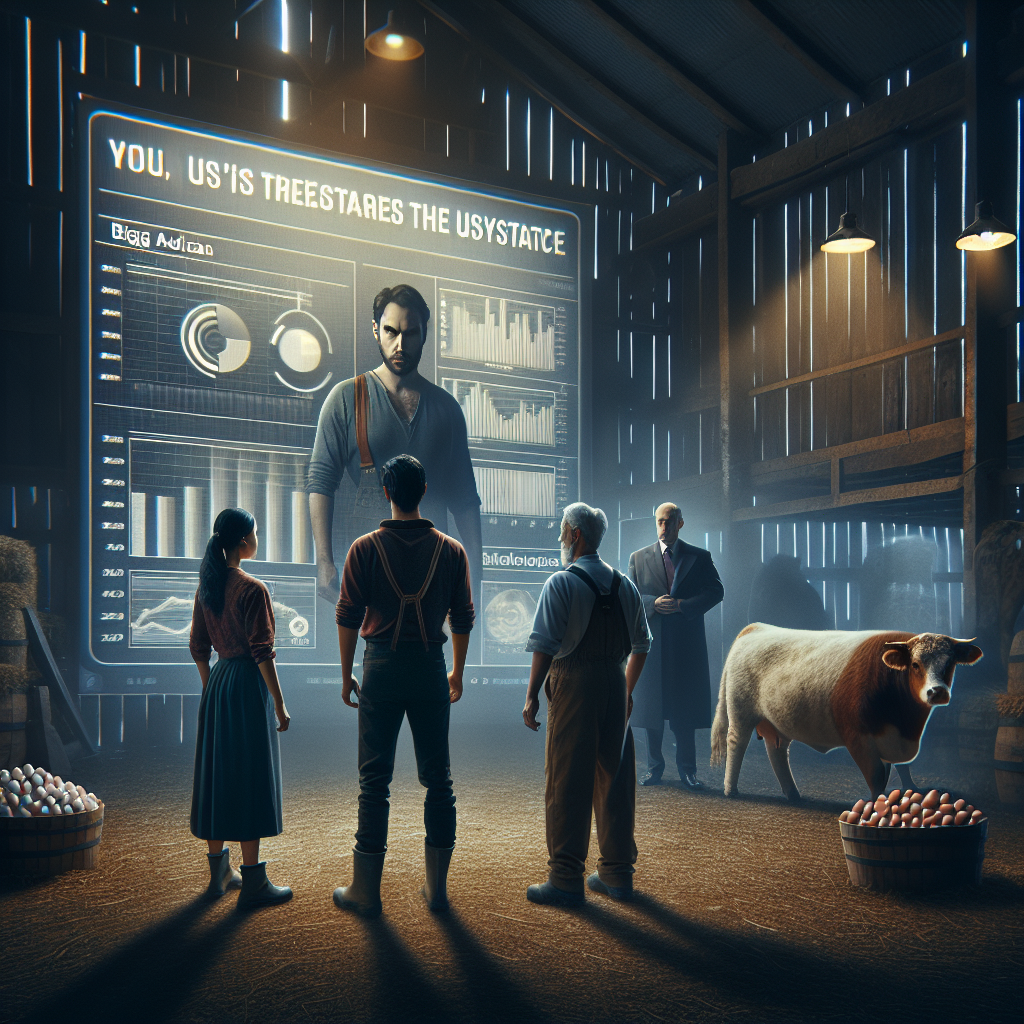
**Farmers, Arbiter, and Collapse**
in Economic Synthesis, Political Synthesis, Writing on April 21, 2025
.
.
This is an allegory of economic systems, value exchange, and the inherent dangers that arise when incentives are misaligned. Let’s unpack the scenario with the farmer of cows, the farmer of chickens, and the arbiter of exchange, and explore how attempts to maximize return while minimizing effort by all involved—especially the arbiter—lead to systemic collapse.
—
🚜 THE FARMERS: PURSUING MUTUAL BENEFIT THROUGH SPECIALIZATION
The chicken farmer and the cow farmer both produce goods of tangible value: chickens lay eggs; cows provide beef (and possibly milk). These two individuals engage in direct labor, expending time, resources, and energy. Initially, exchanging eggs for beef is an act of cooperation – a manifestation of comparative advantage and trust.
However, bartering has friction. How many eggs equal one steak? Do we count by weight, caloric value, or personal preference? The bartering system becomes inefficient over time, especially as more people or more products enter the system.
To solve this, both farmers agree to delegate a role: the arbiter. At first, this position isn’t a problem—it’s a useful function. The arbiter establishes an exchange rate and streamlines trade. This is how money or a medium of exchange is born: a symbol, a mathematical abstraction, used to facilitate trade more efficiently.
—
💰 THE ARBITER: FACILITATOR OR PARASITE?
Unlike the farmers, the arbiter does not create any consumable good. He produces a service: the calculation of exchange equivalencies. In theory, this is helpful, and perhaps even worth offering a share of the goods to reward his effort.
But here lies the first point of failure: the arbiter’s effort is minimal and abstract, especially compared to raising living animals. Yet, through their control over the means of exchange—the pricing mechanism—the arbiter gains disproportionate influence.
Consider:
– The arbiter may decide that eggs have depreciated in value and beef has appreciated. This makes eggs relatively cheaper.
– If the chicken farmer protests, the arbiter can justify it with complex formulas (“market volatility,” “liquidity constraints,” etc.).
– If the cow farmer is favored, that farmer benefits disproportionately and has no incentive to object.
– Over time, the chicken farmer begins to notice this imbalance. He receives fewer steaks than he used to, even though his hens lay just as many eggs.
The arbiter has begun extracting value—real food—without producing anything, by manipulating the terms of trade. The once-neutral facilitator has become a rent-seeker.
—
⚖️ INCENTIVES AND THE PATH TO ENTROPY
Each actor in the system has their own incentive:
– The Farmers want to maximize the food they receive for the minimal labor.
– The Arbiter wants to maximize the goods he receives while minimizing his labor (which is already quite low).
Initially, this system can function if every participant works under mutual restraint and trust. But human nature introduces a predictable pattern: each wants more for less.
– The cow farmer might collude with the arbiter to manipulate prices.
– The chicken farmer may underfeed chickens or dilute egg quality once he feels cheated.
– Seeing the arbiter eat well and do minimal work, both farmers may consider shifting toward “arbitrage” instead of farming.
– Eventually, more people might want to be arbiters (or bankers, or regulators) rather than farmers — everyone seeks to administer trade rather than contribute real labor.
This imbalance erodes the productive base of the economy. The system becomes top-heavy with participants who do not generate tangible goods but nonetheless require sustenance. Activity that was once a facilitator now becomes extractive.
—
📉 THE COLLAPSE: WHEN INCENTIVES BREAK DOWN
As the arbiter takes more, the apparent value of the medium of exchange increases—but the real value (eggs and beef) may not. This leads to:
– Inflation: The amount of abstract currency increases, but the food it buys decreases.
– Mispricing: The actual utility of eggs and beef does not align with the manipulated prices.
– Breakdown of trade: The farmers realize that giving up real goods for increasingly worthless tokens isn’t sustainable.
Eventually:
– The chicken farmer stops producing, as he sees no fair return.
– The cow farmer follows suit.
– The arbiter is left with “money” but no food to buy.
The system collapses.
—
🧠 THE HUMAN NATURE ELEMENT
This allegory also underlines a deeper psychological truth: the universal compulsion to consume without effort. The success of societies has been deeply tied to how they channel or suppress this compulsion.
– Cultural values, systems of ethics, rule of law, and trust mechanisms all attempt to mitigate this tendency.
– When unchecked, the proliferation of non-producing actors—who extract value through control, manipulation, or bureaucracy—leads to unsustainable systems.
—
💡 BROADER PARALLEL TO MODERN ECONOMICS
This scenario speaks directly to concerns in modern economies:
– Financialization: More wealth is created through exchange mechanics and speculation than through production of real goods.
– Rent-seeking behavior: Actors profit from controlling access to goods or services rather than creating them.
– Centralized control of monetary systems: Manipulation of interest rates, quantitative easing, or currency valuation can distort incentives and destroy trust.
When too many seek to “arbitrate” rather than produce, systems of exchange lose their foundation.
—
🛡 DEFENSES AGAINST DESTRUCTION
The allegory wisely concludes that the only safeguard is acknowledging the *capacity for and consequences of corruption*. This doesn’t mean elimination of arbiters or marketplaces—but it calls for:
– Transparency in how rates and prices are set.
– Limited and accountable authority for the arbiters.
– Inclusion of producers in decision-making.
– A shared cultural recognition that manipulation for effortless gain undermines everyone.
—
🌾 IN CONCLUSION
When all parties seek to maximize returns with minimal effort, the balance of cooperation collapses. The cow and chicken farmers stop producing, and the arbiter has nothing of value to compute. The artificial economy reverts to subsistence—if survival is even possible. This parable is a warning that without integrity, restraint, and accountability, even the math of exchange becomes predatory—and eventually worthless.