
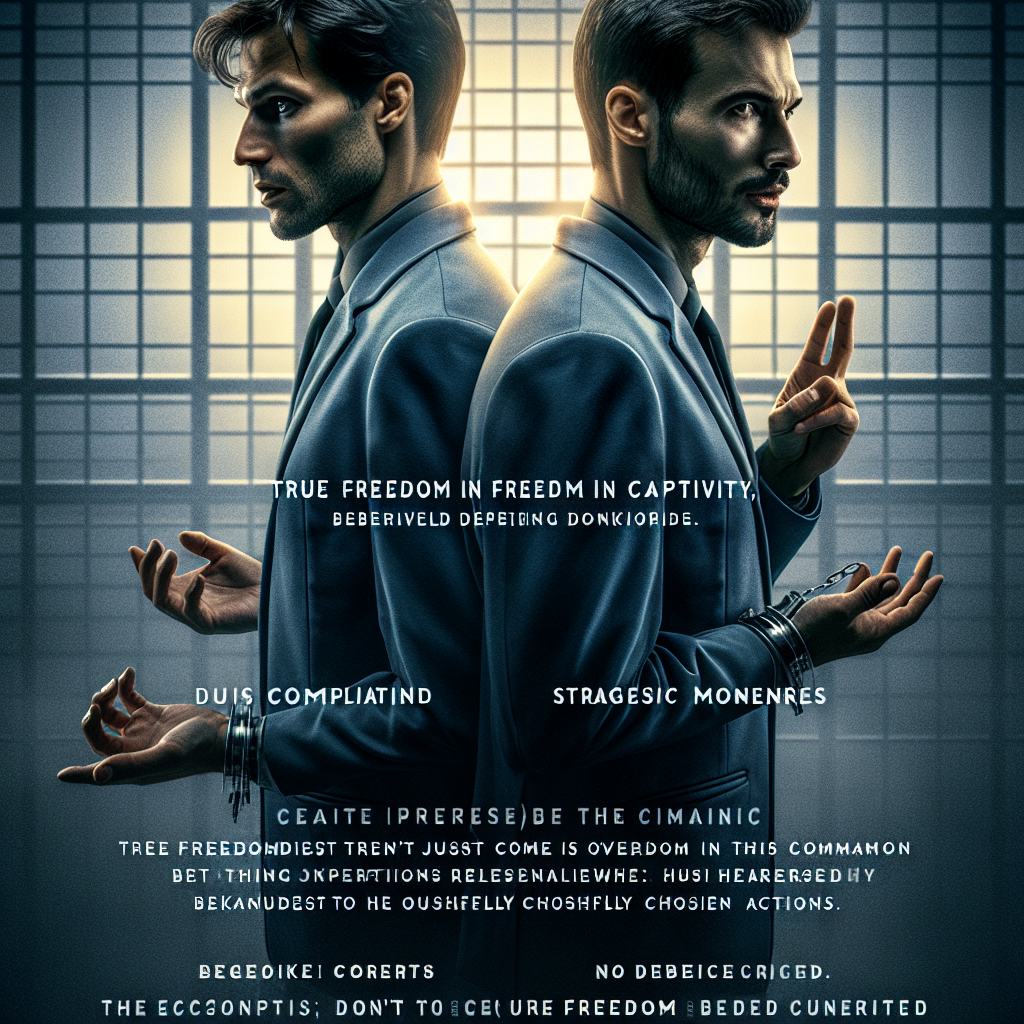
In exploring the paradox of freedom as it relates to rebellion and obedience, consider the scenario of two men held captive and forced into labor. The first man, cautious and compliant, follows instructions faithfully, believing it is his safest course of action. He seems to embody a lack of freedom, confined by his adherence to the captor’s demands. The second man, in contrast, rebels by consistently doing the opposite of what he is instructed. He perceives himself as free because he defies authority. Yet, unbeknownst to him, the captor cleverly manipulates this defiance by providing reverse instructions, rendering the rebellious man more obedient than his compliant counterpart. This metaphor illustrates that rebellion alone is not synonymous with freedom and can indeed be manipulated if it is unreflective and predictable.
True freedom, rather than being an automatic consequence of opposition, necessitates a much deeper level of self-awareness and deliberation. The rebellious man, in his knee-jerk opposition, falls into a predictable pattern. His actions, though seemingly autonomous, are dictated by the captor’s awareness of his innate impulse to rebel. The man who complies cautiously is superficially obedient, yet his awareness of his situation allows for a tactical choice—potentially reserving his energy for moments that require genuine defiance. This juxtaposition underscores the idea that freedom is not solely about opposing authority but is more profoundly linked to the consciousness of one’s choices and motivations.
The scenario is an allegory for broader societal behaviors and political movements, where reactionary behavior is often exploited. In modern contexts, especially in political arenas, oppositional movements can be easily manipulated. Political strategists may employ tactics akin to reverse psychology, inciting predictable reactions from opposition groups to advance their agendas. Such behavior hints at the dazzling yet dangerous illusion of freedom through rebellion. When reactions are not critically examined, they become strings by which controllers can puppeteer outcomes.
A rebel who acts without reflection is vulnerable to manipulation because their actions lack intentionality. Freedom, therefore, requires the ability to regulate impulses and act with deliberation rather than reactively. Self-restraint serves as a protective mechanism against mental manipulation, allowing individuals to make thoughtful choices that reflect true autonomy. When one understands the mechanisms of control, whether in a prison or a societal framework, the path to authentic freedom becomes clearer. It is achieved not through reflexive rebellion but through considered action that transcends the simplistic binaries of obedience and defiance.
In conclusion, the superficial appearance of freedom—the rebellious man in our metaphor—proves to be a weak defense against masterly cunning. True freedom lies in the ability to navigate the complex landscape of choice with awareness and intention. It involves understanding the nuances of one’s environment and inner impulses and acting from a place of considered deliberation. Only then can an individual fully exercise autonomy and resist the subtle manipulations that pervade both captive and free worlds alike. Through self-awareness and self-restraint, one can achieve a deeper, more intrinsic kind of freedom—one that is invulnerable to external control and manipulation.